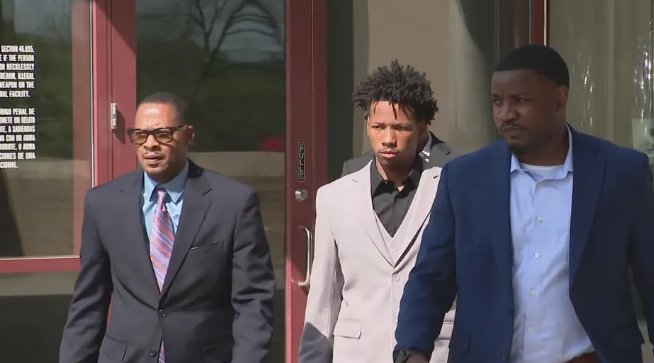
When 17-year-old Karmelo Anthony was arrested and charged with murder following a deadly altercation with another teen, it wasn’t just a personal tragedy—it became a public case study in how race, justice, and youth collide in America’s legal system.
While the facts of the case are still unfolding, what’s already painfully clear is this: Karmelo Anthony was not afforded the same benefit of the doubt that many of his white peers routinely receive. He turned himself in. He cooperated with authorities. He claimed self-defense. Yet instead of compassion or caution, the system handed him a $1 million bond and weeks in jail—long before a trial had even been scheduled.
This isn’t just a story about a criminal case. It’s a story about who the law protects—and who it punishes—when race and power are involved.
Who Is Karmelo Anthony? A Young Man with Promise
Karmelo Anthony is not a hardened criminal. He’s a student-athlete, the captain of his high school football and track teams, and a teenager working two jobs to support himself and his family. Teachers and peers describe him as focused, respectful, and goal-oriented—someone who, by all accounts, was doing everything “right.”
That makes what happened next even more difficult to comprehend.
Following a violent confrontation with another teen, Austin Metcalf, Karmelo claimed that he acted in self-defense. According to public reports and his own statement to police, the incident was not premeditated. There was no attempt to flee, no criminal record, and no effort to hide his involvement. In fact, Karmelo voluntarily turned himself in and gave a statement.
Despite this, his bail was set at a staggering $1 million, a number that raises serious questions about fairness and proportionality in the legal system—especially when white teens charged under similar circumstances often face significantly lower bonds or are released pending trial.
The “Stand Your Ground” Dilemma: Why Race Still Matters
The United States has long allowed individuals to claim self-defense under “Stand Your Ground” laws, which eliminate the duty to retreat when a person feels their life is in danger. These laws are controversial, but widely used—especially by white defendants.
Consider this: George Zimmerman invoked “Stand Your Ground” in the shooting death of 17-year-old Trayvon Martin and walked free. In many other cases, white men have used the law to justify deadly force during road rage incidents, bar fights, and neighborhood disputes.
So why isn’t Karmelo Anthony’s self-defense claim being given equal weight?
The answer lies in a troubling pattern: the legal system often treats Black defendants as guilty until proven innocent.
In Karmelo’s case, the media coverage focused almost exclusively on the weapon he used—not on why he used it. Reports mentioned a “knife” but omitted context about whether he felt cornered, threatened, or overpowered.
There was little public curiosity about the behavior of Austin Metcalf in the moments leading up to the altercation. Why wasn’t there equal investigation into whether Karmelo was defending himself from harm?
The Media Framing: A Bias That Shapes Public Perception
Words matter—especially in the court of public opinion.
From the moment the story broke, headlines painted Karmelo as the aggressor. Terms like “suspect” and “murder charge” dominated coverage, with minimal focus on his cooperation with police, his background, or his potential innocence.
Compare that to the sympathetic tone often extended to white teens involved in violent incidents. Phrases like “troubled past,” “mental health crisis,” or “promising future” are frequently deployed to humanize white defendants. But for Karmelo, the narrative was swift, one-sided, and damaging.
This imbalance in coverage isn’t just unfair—it influences juries, judges, and public trust in the justice system.
A Tragedy for Two Families—But Only One Side Gets Scrutinized
It’s important to say this clearly: the death of Austin Metcalf is a tragedy. A young life was lost, and his family deserves answers and space to grieve. There are no winners in a case like this.
But mourning cannot override the need for due process. Justice cannot mean automatically criminalizing the surviving teen without a fair investigation. If we truly believe in the justice system, then both sides deserve scrutiny—not just one.
The Community Response: Not Just Hope—A Demand for Fairness
Karmelo Anthony’s release on a reduced bond marked a temporary victory for his family and supporters—but it did not erase the fact that he was treated more harshly than others in similar circumstances.
Local activists, civil rights leaders, and community members have rallied around his case, not just out of sympathy, but out of recognition: this story feels all too familiar.
“We’ve seen this pattern before—Black teens criminalized before the facts are known,” said Kendra Rollins, a youth advocate based in North Carolina. “It’s about time we stop accepting it.”
Original Analysis: When Survival Becomes a Crime
There’s a cruel irony at the heart of Karmelo Anthony’s case. He was doing everything society asks of young Black men:
- Staying in school
- Working jobs
- Leading athletic teams
- Cooperating with law enforcement
And yet, the moment he acted in self-preservation, the system moved swiftly to label him a threat.
His real “crime”? Surviving a conflict he didn’t start.
This reflects a deeper truth about how American justice operates: Black boys are often not seen as children. They are seen as threats. And when they act to defend themselves, even within the legal bounds of self-defense, they are punished—not protected.
What Happens Next: The Road Ahead
Karmelo Anthony still faces serious legal charges. His life hangs in the balance. But what’s also at stake is our national integrity. If “Stand Your Ground” and due process are to mean anything, they must be applied consistently—not based on skin color, economic status, or media narratives.
Karmelo deserves more than judgment. He deserves justice. He deserves a fair trial. And he deserves to be seen as a full human being—not just a mugshot or a headline.
Conclusion: Justice Cannot Be Selective
Karmelo Anthony’s case is not just a legal matter—it’s a moral one.
It challenges us to examine how justice is applied in this country and who we instinctively believe deserves its protections. If we only extend compassion and legal protection to some, then justice becomes something far worse: a tool of exclusion, not fairness.
Let’s ensure that Karmelo’s story isn’t just a moment, but a movement—a reminder that true justice must be colorblind, compassionate, and rooted in equal rights for all.
📢 Take Action
- Share Karmelo’s story on social media to raise awareness
- Contact your local officials and demand transparency in cases involving self-defense
- Support organizations advocating for legal equity and youth justice reform
📰 BLKsignal News is committed to telling the stories that mainstream media often ignores. We investigate where truth meets injustice and amplify the voices of those fighting to be heard.
👉 Follow us for updates on Karmelo Anthony’s case and others like it.
Discover more from BLKsignal News
Subscribe to get the latest posts sent to your email.